
Published
Labour Migration from Kosi-Seemanchal Regions of Bihar: Trends and Patterns (2000-2025)
,
Published in July-Dec 2026 (Vol. 1, Issue 1, 2026)
Abstract
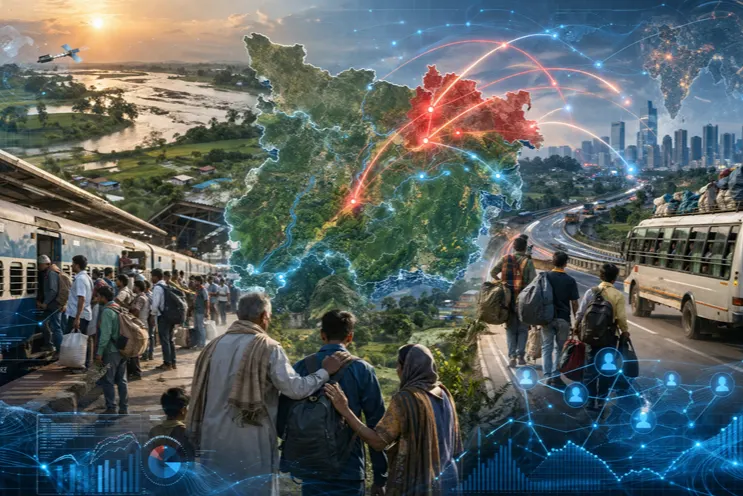
Migration is an integral part of human history. The Kosi-Seemanchal region of Bihar is a socio-economically backward area dominated by agricultural and allied economic activities, where unemployment and poverty are the principal drivers of out-migration. Inequality in economic development, arising from the uneven spread of the Green Revolution across the region, is the principal cause of large-scale rural out-migration of labour. As economic considerations increasingly shape rural livelihoods, migrant labourers are compelled to search for better wages elsewhere. The development purposive of rapid transportation and communication has further reshaped migration trends and patterns over time.
The present paper analyses the trends and changing pattern of labour migration from the Kosi-Seemanchal region. The study is based on primary data collected from 300 migrant labourers through a multi-stage sampling design (selection of Community Development Blocks, followed by random sampling of migrant households within each block) across seven Community Development Blocks of the Kosi-Seemanchal region. The study covers the period 2000-2025, with data analysed at five-year intervals. Descriptive statistics were applied, and MS Excel and ArcGIS software were used to visualise migration flow and the spatial distribution of migrant labor.
The results show that migrant labourers are shifting from the traditional destinations of north-western India towards western and southern India. Seasonal migration remains the dominant type of movement in this area, although the pattern is gradually shifting from short-term to longer-term inter-state migration, altering the occupational structure of the population. The large-scale out-migration of labour from the study area is also creating labour scarcity in the region's own farming and construction sectors.
References
- [1]Anand, A. (2025). In search of a better life: A comprehensive study of migration patterns and outcomes of migrants from Bihar in Delhi. International Journal of Arts Humanities and Social Studies, 7(2), 186–193. https://doi.org/10.33545/26648652.2025.v7.i2c.300
- [2]Census of India. (2011). Provisional population totals. Office of the Registrar General & Census Commissioner, India, Ministry of Home Affairs, Government of India.
- [3]Cleaver, H. M. (1972). The contradictions of the Green Revolution. The American Economic Review, 62(1/2), 177–186.
- [4]Datta, A. (2019). Continuity and change: Migration and development in India: The case of Bihar (Doctoral dissertation, Erasmus University Rotterdam). https://repub.eur.nl/pub/115666/approved-529178-L-bw-Datta.pdf
- [5]Datta, A. (2025). Migration from contemporary Bihar. In D. K. Mishra (Ed.), Internal Migration in Contemporary India (2nd ed., pp. 138–152). Routledge India. https://doi.org/10.4324/9781003674894
- [6]Dewan, R. (2013). Study of Kosi flood disaster on migrant children of Bihar, India. IOSR Journal of Humanities and Social Science (IOSR-JHSS), 7(4), 44–50.
- [7]Gosal, G. S. (1961). Internal migration in India: A regional analysis. The Indian Geographical Journal, 36(3), 106–121.
- [8]Harris, J. R., & Todaro, M. P. (1970). Migration, unemployment and development: A two-sector analysis. The American Economic Review, 60, 126–142.
- [9]Indian Institute for Human Settlements. (2012). Urban India 2011: Evidence. Indian Institute for Human Settlements.
- [10]Indian Institute of Public Administration. (2010). A study of Bihari migrant labourers: Incidence, causes and remedies. Sponsored by the Department of Labour Resources, Government of Bihar.
- [11]Kumar, A., & Kumar, M. (2020, June 13). Marginalised migrants and Bihar as an area of origin. Economic & Political Weekly, 55(24), 21–24. https://www.epw.in/journal/2020/24/commentary/marginalised-migrants-and-bihar-area-origin.html
- [12]Kumar, P. (2020). Problems of labour migration from Bihar. International Education and Research Journal, 6(9). http://ierj.in/journal/index.php/ierj/article/view/2251/2133
- [13]Kumar, P., & Jha, M. K. (2018). From Kosi to Delhi: Life and labour of the migrants. In R. Samaddar (Ed.), Migrants and the Neoliberal City (pp. 307–329). Orient BlackSwan.
- [14]Kumar, R., & Shekhawat, S. (2024). Migratory movements: Dissecting the causes and patterns from Bihar's Kosi Division. Migration & Diversity, 3(4). https://doi.org/10.33182/md.v3i4.3305
- [15]Kumar, R., Shekhawat, S., & Singh, M. (2025). Unravelling migration dynamics: A socio-economic examination of Bihar's Kosi Division migration phenomenon. Research Square. https://doi.org/10.21203/rs.3.rs-6252230/v1
- [16]Kumari, P. (2025). Reverse migration during the COVID-19 pandemic in Bihar. International Journal for Multidisciplinary Research, 7(6). https://doi.org/10.36948/ijfmr.2025.v07i06.63029
- [17]Lee, E. S. (1966). A theory of migration. Demography, 3(1), 47–57. https://doi.org/10.2307/2060063
- [18]Madhuri, M., Tewari, H. R., & Bhowmick, P. K. (2014). Livelihood vulnerability index analysis: An approach to study vulnerability in the context of Bihar. Jàmbá: Journal of Disaster Risk Studies, 6(1). https://doi.org/10.4102/jamba.v6i1.127
- [19]Mathew, S., & Moore, M. (2011). State incapacity by design: Understanding the Bihar story (IDS Working Paper No. 366). Institute of Development Studies. https://www.ids.ac.uk/download.php?file=files/dmfile/Wp366.pdf
- [20]Mohan, S., & Kumar, M. (2024a). Rightless migration in India: A study of inefficiency and sufferings sprouting in the agricultural fields of Bihar. Journal of Ecohumanism, 3(8). https://doi.org/10.62754/joe.v3i8.5472
- [21]Nazim, M. (2019). Population migration: A socio-economic analysis. Rajesh Publications.
- [22]Nazim, M., & Ranjan, A. (2024). Rainfall variability trends and its impact on crop production in North Bihar. Geographical Outlook, 33(1), 1–16.https://www.researchgate.net/publication/400089300_Rainfall_Variability_Trends_and_its_Impact_on_Crop_Production_in_North_Bihar
- [23]Ravenstein, E. G. (1889). The laws of migration. Journal of the Royal Statistical Society, 52(2), 241–305. https://doi.org/10.2307/2979333
- [24]Rehman, A. (2025, July 10). Bihar migrants in Delhi worried about electoral roll revision back home: “How will I prove who I am and where I am from?” The Indian Express.
- [25]Rodgers, G., Datta, A., Rodgers, J., Mishra, S. K., & Sharma, A. N. (2013). The challenge of inclusive development in rural Bihar. Institute for Human Development in association with Manak Publications. https://www.ihdindia.org/rpb/pdf/bihar-book-ihd-2013.pdf
- [26]Sahani, R. K., Badiger, S., Samrat, A., & Krishnan, S. (2023). Flood frequency and flood intensity changes in the post-embankment period in the Kosi sub-basin, India: Impact of location, caste, and class on the flood vulnerability of marginal communities. Frontiers in Water, 5, Article 1017945. https://doi.org/10.3389/frwa.2023.1017945
- [27]Stark, O., & Bloom, D. E. (1985). The new economics of labor migration. The American Economic Review, 75(2), 173–178. https://www.jstor.org/stable/1805591
- [28]Todaro, M. P. (1969). A model of labor migration and urban unemployment in less developed countries. The American Economic Review, 59(1), 138–148. http://www.jstor.org/stable/1811100
- [29]World Bank Group. (2016). Bihar: Poverty, growth and inequality (World Bank Group Brief). https://documents1.worldbank.org/curated/en/781181467989480762/pdf/105842-BRI-P157572-PUBLIC-Bihar-Proverty.pdf
Authors (2)
Ashish Ranjan
Patna UniversityPatna UniversityPatna UniversityPatna University
View all publications →Download Article
Summarise this paper with AI:
Article Information
Published in:
July-Dec 2026 (Vol. 1, Issue 1, 2026)Article Impact
Views:3,159
Downloads:1,973
How to Cite
Ranjan, A., & Nazim, D. (2026). Labour Migration from Kosi-Seemanchal Regions of Bihar: Trends and Patterns (2000-2025). Geographical Studies and Development, 1(1), 91-111. https://geographicalstudies.com/articles/GSD110007
Article Actions
More from this Issue
Machine-learning-based two-dimensional building exposure assessment to rainfall-triggered landslides in the South Sikkim Himalaya
Shivam PriyadarshiRead more →