
Published
Pre-Monsoon Water Quality Degradation Along the Punpun River from Pali to Fatuha Blocks, Patna District: Implications for Aquatic Habitat Suitability
,
Published in July-Dec 2026 (Vol. 1, Issue 1, 2026)
Keywords
Abstract
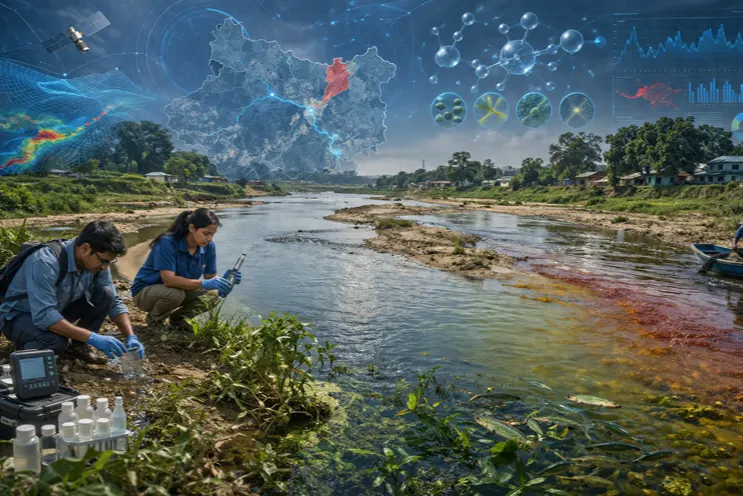
The Punpun River, a major tributary of the Ganga originating near the Palamu region of Jharkhand, traverses roughly 64 km between sampling sites from Pinjrawan (Pali block) to Sammaspur (Fatuha block) of Patna district before its confluence with the Ganga near Fatuha. This study presents a pre-monsoon (18–20 April) comparative assessment of physico-chemical water quality at the river’s entry point into the district (Pinjrawan) and its exit point (Sammaspur) immediately before the Ganga confluence. Fourteen parameters—temperature, pH, total dissolved solids (TDS), electrical conductivity (EC), total hardness, calcium, magnesium, chloride, sulphate, nitrate, alkalinity, turbidity, dissolved oxygen (DO) and biochemical oxygen demand (BOD)—were evaluated against BIS (2012) desirable and permissible limits. At Pinjrawan, all major ionic and nutrient parameters remained within desirable limits; DO (7.88 mg L⁻¹) and BOD (2.91 mg L⁻¹) indicated a well-oxygenated, low-pollution stretch, although turbidity (21.82 NTU) exceeded the permissible limit. At Sammaspur, TDS, total hardness, magnesium and alkalinity had crossed the desirable limit (remaining within the permissible limit), DO had declined to 5.77 mg L⁻¹, BOD had risen to 4.93 mg L⁻¹, and turbidity had risen sharply to 158.5 NTU. The consistent downstream increase across nearly all parameters indicates a pronounced longitudinal degradation gradient over the 64 km stretch, plausibly linked to agricultural return flow, domestic sewage inflow and industrial effluent discharge, in addition to natural evaporative concentration and sediment loading. While the river remains largely within drinking-water-adjacent limits for major ions at both sites, turbidity is a basin-wide concern and the exit stretch shows early signs of organic enrichment. Both sites nominally meet CPCB (2008) criteria for fish and wildlife propagation (DO, pH), but literature turbidity–biota thresholds suggest the entry site’s benthic community is already under sediment-related stress and the exit site’s high turbidity and narrower DO margin are less favourable for fish foraging and respiratory efficiency. Findings are presented as a preliminary longitudinal signal; an expanded, seasonally replicated monitoring design incorporating direct biological survey is recommended.
References
- [1]Antil, S., Maurya, S., Dagar, J., Bhagat, P., Makhija, S., & Toteja, R. (2024). Insights into water quality of River Yamuna, India: A comprehensive spatial-temporal analysis using advanced indices and multivariate statistical techniques. Research Square. https://doi.org/10.21203/rs.3.rs-4072812/v1
- [2]APHA. (2024). Standard methods for the examination of water and wastewater (25th ed.). American Public Health Association.
- [3]BIS. (2012). IS 10500:2012 — Indian standard drinking water specification (second revision). Bureau of Indian Standards.
- [4]Central Pollution Control Board. (2008). Guidelines for water quality management. CPCB, New Delhi.
- [5]Chapman, P. M., Bailey, H. C., & Canaria, E. (2000). Toxicity of total dissolved solids associated with two mine effluents to chironomid larvae and early life stages of rainbow trout. Environmental Toxicology and Chemistry, 19(1), 210–214. https://doi.org/10.1002/etc.5620190125
- [6]Davies-Colley, R. J., & Smith, D. G. (2001). Turbidity, suspended sediment, and water clarity: A review. Journal of the American Water Resources Association, 37(5), 1085–1101. https://doi.org/10.1111/j.1752-1688.2001.tb03624.x
- [7]Henley, W. F., Patterson, M. A., Neves, R. J., & Lemly, A. D. (2000). Effects of sedimentation and turbidity on lotic food webs: A concise review for natural resource managers. Reviews in Fisheries Science, 8(2), 125–139. https://doi.org/10.1080/10641260091129198
- [8]Iqbal, K., Ahmad, S., & Dutta, V. (2019). Pollution mapping in the urban segment of a tropical river: Is water quality index (WQI) enough for a nutrient-polluted river? Applied Water Science, 9(8), Article 191. https://doi.org/10.1007/s13201-019-1083-9
- [9]Kumar, A., Paul, B., Mudra, L., & Kishor, N. (2011). Studies of selected water quality parameters of River Ganges at Patna, Bihar. SHILAP Revista de Lepidopterología.
- [10]Olson, J. R., & Hawkins, C. P. (2017). Effects of total dissolved solids on growth and mortality predict distributions of stream macroinvertebrates. Freshwater Biology, 62(4), 779–791. https://doi.org/10.1111/fwb.12901
- [11]Preetham, K. P., G, P. G. T., Sahana, A. S., Shridhara, J. K., & Mahadevaiah, T. (2023). Analysis of drinking water quality in Honakere Hobli. International Journal for Research in Applied Science and Engineering Technology, 11(6), 2996–3018. https://doi.org/10.22214/ijraset.2023.54162
- [12]Priyadarshee, A., Rahul, A. K., Kumar, V., Kumar, A., & Kumar, N. (2024). Spatial variation in water quality of the Burhi Gandak River: A multi-location assessment. Frontiers in Environmental Science, 12, Article 1487469. https://doi.org/10.3389/fenvs.2024.1487469
- [13]Ranjan, R., Kaushik, H., & Ranjan, R. K. (2024). Assessment of hydrochemical characteristics and trace metals of Punpun River water – a tributary of the Ganga River. Water Science & Technology: Water Supply, 24(5), 1875–1892. https://doi.org/10.2166/ws.2024.096
- [14]Ranjan, S., & Singh, V. P. (2023). ANN and GRNN-based coupled model for flood inundation mapping of the Punpun River Basin. Engineering, Technology & Applied Science Research, 13(1), 9941–9946. https://doi.org/10.48084/etasr.5483
- [15]Ravindra, K., Ameena, Meenakshi, Monika, Rani, & Kaushik, A. (2003). Seasonal variations in physico-chemical characteristics of River Yamuna in Haryana and its ecological best-designated use. Journal of Environmental Monitoring, 5(3), 419–426. https://doi.org/10.1039/b301723k
- [16]Sharma, D., & Kansal, A. (2011). Water quality analysis of River Yamuna using water quality index in the national capital territory, India (2000–2009). Applied Water Science, 1, 147–157. https://doi.org/10.1007/s13201-011-0011-4
- [17]Shil, S., Singh, U. K., & Mehta, P. (2019). Water quality assessment of a tropical river using water quality index (WQI), multivariate statistical techniques and GIS. Applied Water Science, 9(7), Article 168. https://doi.org/10.1007/s13201-019-1045-2
- [18]Tejprakash. (2020). Assessment of quality characteristics of underground water using water quality index – A case study of rural areas from Gwalior District. International Journal for Research in Applied Science and Engineering Technology, 8(8), 671–679. https://doi.org/10.22214/ijraset.2020.30993
- [19]Wilkes, M., Gittins, J. R., Mathers, K. L., Mason, R., Casas-Mulet, R., Vanzo, D., Mckenzie, M., Murray-Bligh, J., England, J., Gurnell, A. M., & Jones, J. I. (2018). Physical and biological controls on fine sediment transport and storage in rivers. WIREs Water, 6(2), e1331. https://doi.org/10.1002/wat2.1331
- [20]Zafar, M. M., & Kumari, A. (2024). Spatio-temporal evaluation of the impact of anthropogenic stressors on physico-chemical characteristics and water quality of the River Ganga using GIS-based approach in the middle Gangetic Plains at Patna, Bihar, India. Water Science & Technology, 89(5), 1382–1400. https://doi.org/10.2166/wst.2024.053
Authors (2)
Zaofeshan Anjum
Patna UniversityPatna UniversityPatna UniversityPatna University
View all publications →Download Article
Summarise this paper with AI:
Article Information
Published in:
July-Dec 2026 (Vol. 1, Issue 1, 2026)Article Impact
Views:2,392
Downloads:964
How to Cite
Ashraf, M., & Anjum, Z. (2026). Pre-Monsoon Water Quality Degradation Along the Punpun River from Pali to Fatuha Blocks, Patna District: Implications for Aquatic Habitat Suitability. Geographical Studies and Development, 1(1), 77-90. https://geographicalstudies.com/articles/GSD110006
Article Actions
More from this Issue
Machine-learning-based two-dimensional building exposure assessment to rainfall-triggered landslides in the South Sikkim Himalaya
Shivam PriyadarshiRead more →